The convention was an amazing experience—I felt like Harry Potter arriving at Hogwarts!
Tony DaSilva
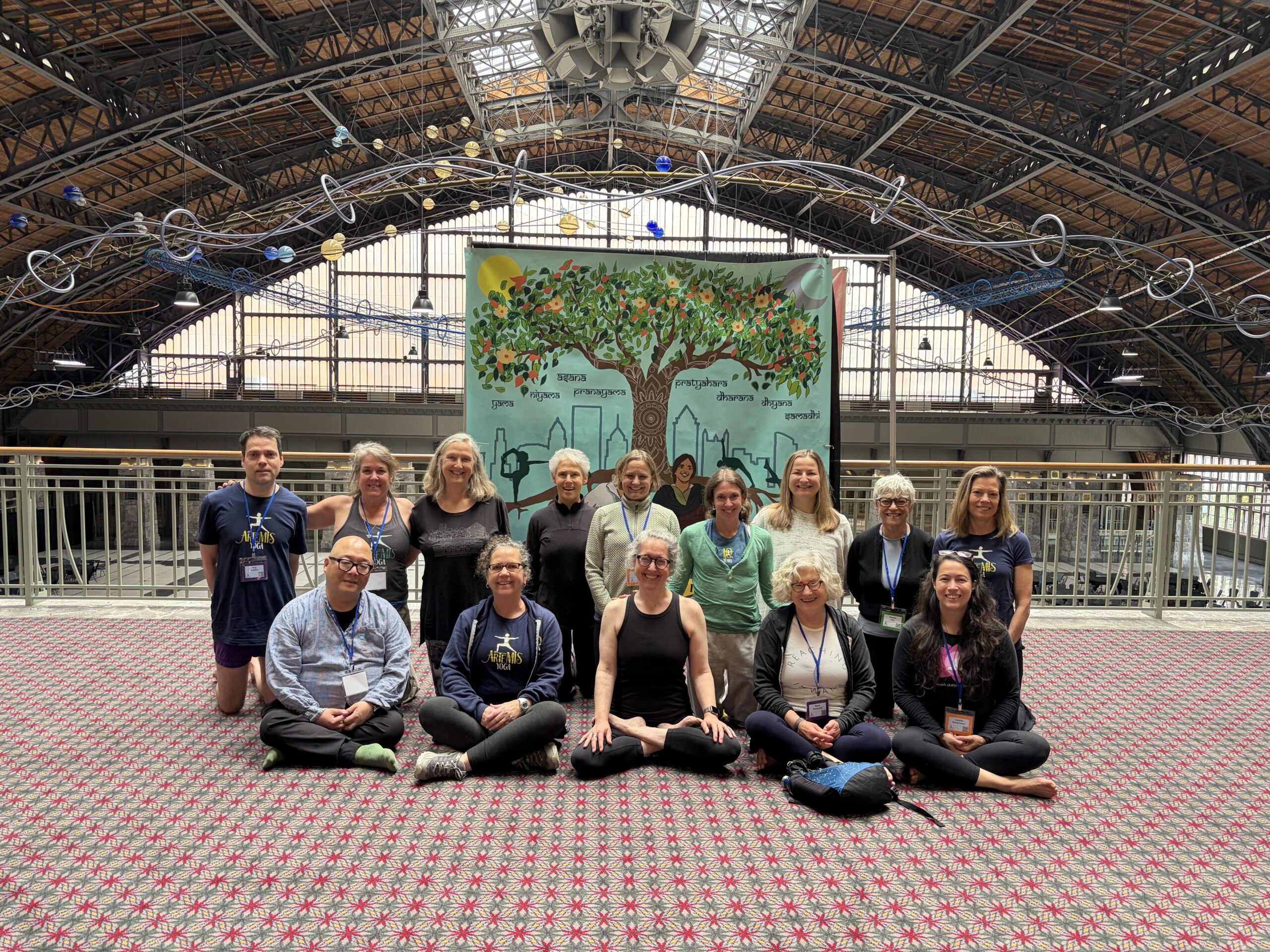
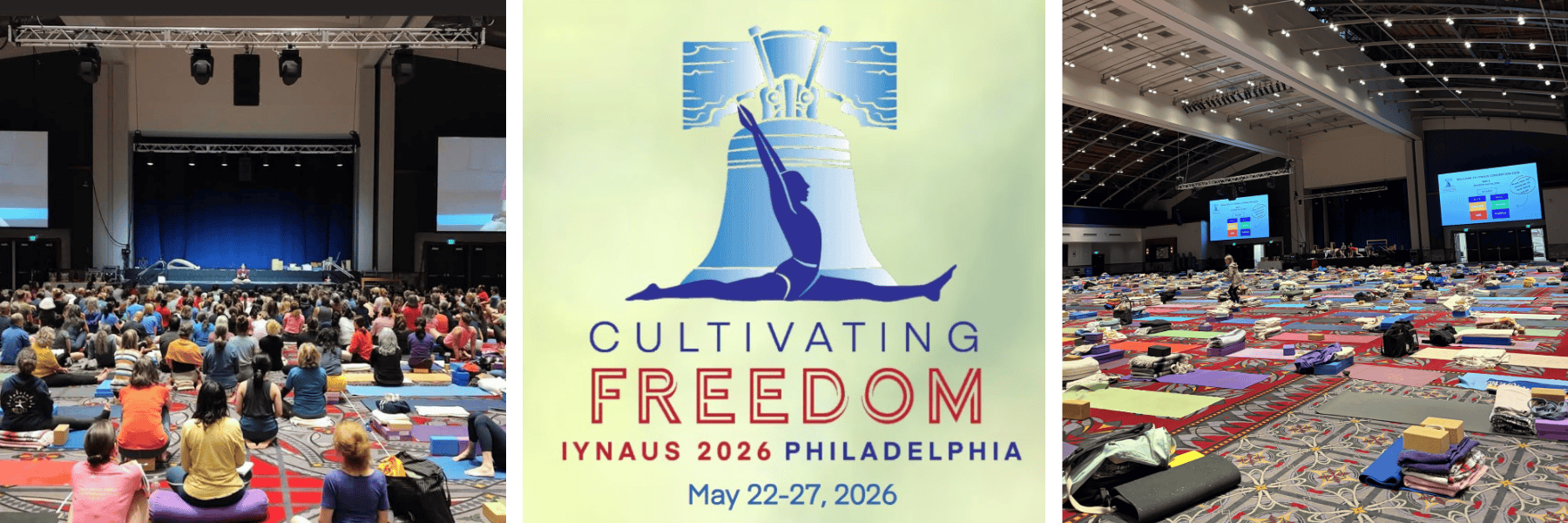
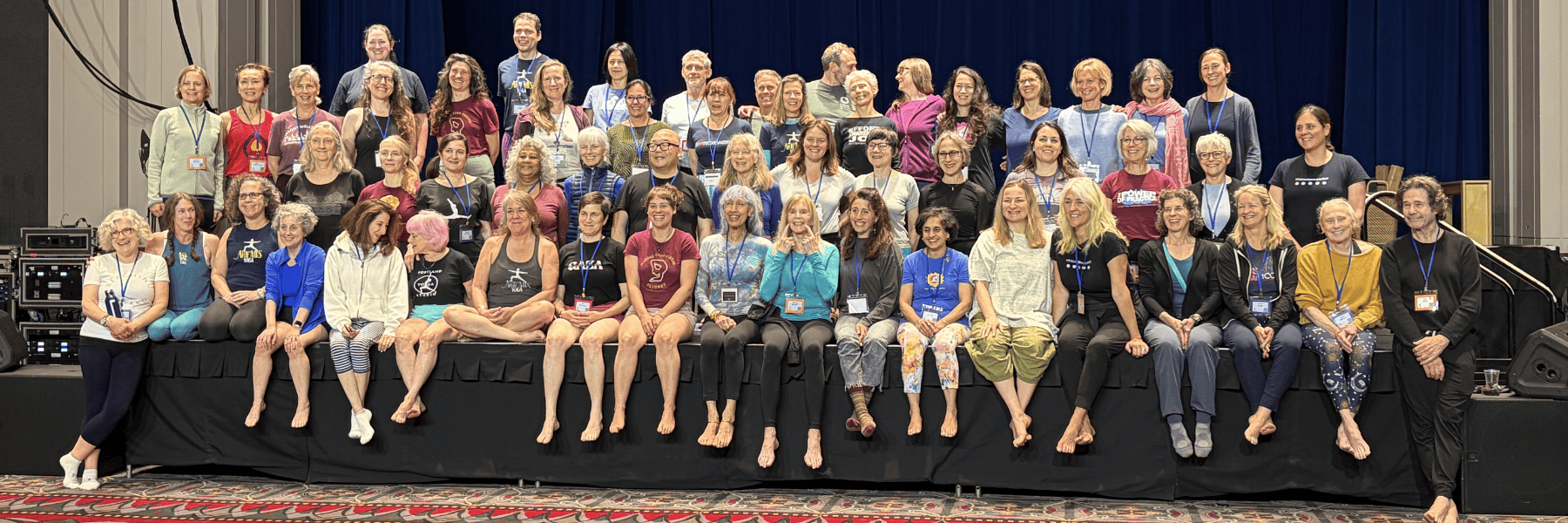
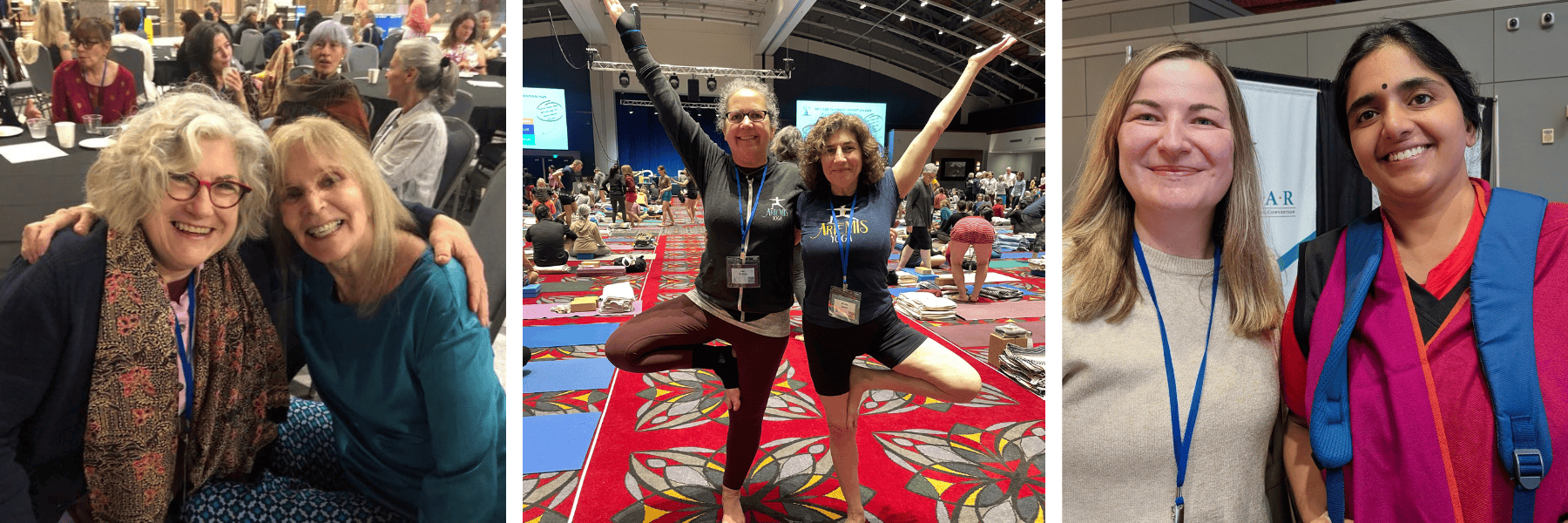
Over Memorial Day weekend, many Artemis Yoga teachers and students traveled to Philadelphia to attend the 2026 IYNAUS Convention, a gathering of the Iyengar Yoga National Association of the United States. The Iyengar Yoga National Association of the United States hosts these conventions every three years in different regions of the country, and this was the first held in the Northeast in quite some time, drawing a strong contingent of New England Iyengar yogis.
This year’s theme, “Cultivating Freedom,” featured Abhijata Iyengar as the keynote presenter. The program offered five days of practice sessions, three times daily, along with rich conversations, community, and more than a little fun. The setting felt especially fitting: Philadelphia, in this 250th anniversary year of our nation, offered a powerful backdrop for exploring what freedom truly means. To walk the streets where the Declaration of Independence was signed, to stand before the Liberty Bell, and to carry that spirit into the real world, asking how we might find freedom in our own bodies, gave the theme a resonance beyond the mat.
More than 770 practitioners filled the ballrooms of the Philadelphia Convention Center, with over 200 more joining online. It was an extraordinary experience. We have gathered reflections from several Artemis Yoga teachers and students who attended, and in this special edition, we are delighted to share them with you. When you see these teachers, ask them more; they will surely be weaving these insights into their classes.
Finding freedom in the quotidian is far more satisfying than waiting for the big moments.
Danielle da Cruz
Reflections from Liz Padula
This was my first convention. As a student, I’ve always loved when my teachers returned from these gatherings and shared what they had learned. There’s always an invigorating freshness to those insights, new ideas for practice and teaching. I was thrilled to finally experience it myself.
There were so many takeaways it’s hard to single out just one. I was deeply impressed by the generosity of presenter Abhijata Iyengar, who shared her years of accumulated knowledge with such openness. She is not yet 40, a working mother, yet she grew up alongside her grandfather BKS Iyengar and her aunt Geeta learning the foundational pillars of Iyengar yoga.
Among my key takeaways: trust yourself. Be creative in your own practice. Ask, what happens if I try this? Explore the sequence of poses. Investigate what you think you already know. I loved being reminded to take what you discover in your own practice and bring it into teaching with care and discernment. And the theme of finding freedom in practice resonated deeply: you don’t have to sequence poses the same way every time. Skip straight to Ardha Chandrasana. Return to Trikonasana. Mix it up.
I also appreciated the way Abhijata deconstructed asanas and revealed surprising connections between seemingly different poses Janu Sirsasana and Parsvottanasana, for example.
My overall takeaway was simple: trust the words of the theme, “Cultivate Freedom”. Your body and your students too hold the wisdom for your teaching and for your own practice. As a practitioner, I found Abhi’s integration of more playfulness, more vinyasa, and more weight-bearing in fresh, innovative ways genuinely exciting and I am looking forward to exploring that more with myself and with students.
Reflections from Jarvis Chen
It was lovely to attend the 2026 IYNAUS convention, “Cultivating Freedom,” with so many old friends and valued colleagues. It was particularly nice that so many from our Artemis Yoga community were able to attend, including many students attending a Iyengar Yoga convention for the first time.
Abhijata’s teaching was wonderfully clear and penetrating. Her teaching combines so many threads from Guruji, Geetaji, and Prashantji, filtered through her own experience and practice. She has a unique ability to communicate the essence of Iyengar Yoga with joy, reflection, and insight.
I particularly appreciated one of her themes, which was to encourage us to explore our own inner experience of asana and pranayama in order to understand the inner mind. To achieve this, we have to go beyond “spoon feeding” and approach the self experimentation aspect of practice with courage and sensitivity. I trust that the inspiration and imprints of the time practicing and learning together will stay with me for a long time.
Reflections from Rahel Wasserfall
My major take away is Abhi’s teaching about the freedom to be creative. Abhi pointed to creativity as emerging from a deep dive into your practice which is both action and abiding . Creativity comes from knowing your sources, your tradition and it also requires trusting yourself. You need both a strong tradition and a playful attitude! That is the freedom that practice (Abhyasa and vairagyah) brings.
Reflections from Mary Wixted
For me, the best freedom that dedicated yoga practice imparts is the freedom from acting from the reactive mind. My practice has given me moments of pause which allow me, in blessed moments, to hear the call of the authentic self and to act in the world in accordance with that voice. This ability comes from keen witnessing and observing in asana.
During the convention, the most powerful lesson Abhijata brought me was a process of self-reliance in understanding what to do and not to do in an asana, when confronted with our own problems and those of our students. She asked us to come into the “natural/neutral” pose, what I interpreted as taking the shape without deep reflection. She asked us not to forget our knowledge of the asana’s basic instructions, but to first observe what is needed day to day, moment to moment. This required a pause early on in striking of the asana, a present witnessing of actual conditions, and then measured action towards greater balance and spaciousness.
She showed us perhaps BKS Iyengar’s own processing at his beginning, for although he had a guru, he had no asana teacher and he had to discover everything on his own. In this earlier pause before action, I observed new sensations and conditions of my body, and acted in a more holistic and helpful way. My body and mind were brought into a more intuitive and reflective conversation with each asana.
The only way to overcome fear is to take action.
Abhijata Iyengar
Reflections from Irina Sidorenko
On Sutra I.43 — Nirvitarka Samāpatti
There is a moment in practice — when the posture stops being something you are doing and becomes something that is simply happening. Instruction falls away. Memory falls away. What remains is a luminous attention that belongs neither to the thinking mind nor to the remembering self. Patanjali names this state nirvitarka samāpatti, and Sutra I.43 describes its threshold: the difference between memory and intellectual illumination is disclosed; memory is cleansed, and consciousness shines without reflection.
BKS Iyengar illuminates this sutra with characteristic precision. He teaches that the mind ordinarily superimposes layers of prior knowledge, comparison, and linguistic labeling onto every object of perception. We do not see what is — we see what we remember. In nirvitarka samāpatti, these layers are burned away. The object is perceived in its essential nature, without the distorting lens of conditioned experience. Consciousness, freed from the habit of looking through memory rather than looking directly, becomes translucent. It shines, as Guruji writes, like a polished mirror that reflects without adding anything of its own.
Abhijata carried this teaching into the body with a directness that felt like a gift. What asana does for you, she reminded us, is better than any instruction. A teacher — even the finest teacher — is only a guide. The posture itself is the real teacher, and it is inexhaustibly intelligent. We come to the mat with notebooks full of cues, with muscle memory accumulated across years, with the ghost of every correction a beloved instructor ever gave us. All of this has its place. Memory is not the enemy; it is the launching pad. We use memory from past experiences to go further, to greater heights. But memory becomes a ceiling the moment we refuse to look beyond it. If we only depend on what we already know, Abhijata told us, newer things will not come. The tradition does not ask us to forget — it asks us to hold what we have learned lightly enough that revelation can still arrive.
This is the subtle work of an open mind. In Iyengar practice we are trained to observe minutely — the angle of the outer heel, the lift behind the sternum, the quality of breath moving into the back ribs. But observation can calcify into anticipation, and anticipation is memory wearing the mask of presence. We enter a pose already knowing how it will feel, what will resist, which instruction to apply. The body, in its infinite wisdom, has already moved — but the mind has not yet listened. Abhijata placed her finger precisely on this gap: our reactions are so rapid that we think they are our responses. The mind, trained by evolution and habit to shield us from discomfort, intercepts the body’s actual signal and substitutes a pre-fabricated response. Yoga teaches us to slow that interception. It teaches us to pause — not to suppress the mind, but to unravel it — to develop the skill, as Abhijata said, of meeting what is actually here rather than what the mind has already decided must be here. Body intelligence, she insisted, is more real than mind intelligence. It is older, quieter, and far more honest.
Here Patanjali’s psychology becomes startlingly contemporary. The ordinary mind, he observes, moves toward what gives pleasure and recoils from what does not. This rāga and dveṣa — attraction and aversion — are not merely emotional tendencies, they are distortions. We do not perceive the posture; we perceive our relationship to it. The hamstring that has always been tight becomes an identity. The backbend that once opened effortlessly becomes an expectation. What we like, we grasp; what we dislike, we armor against. In both cases, we have stopped listening. Viveka — discriminative understanding — is, as Abhijata reminded us, not optional. It is the essential faculty that allows the practitioner to see clearly: to know what is memory and what is this moment, what is protection and what is intelligence, what is the past teaching us and what is the pose revealing that no past teaching could have predicted.
Nirvitarka samāpatti is not, then, a state that erases what has been learned. It is the state in which learning is finally complete — so fully absorbed that it no longer stands between us and direct perception. Guruji used to say that the body is the bow, the asana is the arrow, and the soul is the target. What Philadelphia convention reminded us is that the bow must be strung not with certainty, but with inquiry. Not with the closed hand of accumulated knowledge, but with the open palm of attention. Memory cleansed does not mean memory lost. It means memory so fully composted into the practitioner’s being that it becomes invisible — the ground beneath the feet rather than the voice in the head.
In these days together, Abhijata showed us what it looks like when a teacher has traveled that far. She did not stand apart from the practice and describe it. She moved through it with us, inviting us to stop performing what we know and begin discovering what we do not yet know we are capable of. The convention’s theme — Cultivating Freedom — is nothing less than this: freedom from the tyranny of our own habitual seeing, so that consciousness may, for a moment, shine without reflection.
That moment, Patanjali tells us, is not distant. It lives in the next breath, in the next adjustment of the inner wrist, in the next willingness to be surprised by a posture you have done ten thousand times. The asana is waiting. The door is open.
Reflections from Danielle da Cruz
I loved Abhi’s encouragement to find freedom in the small things.
As with joy or contentment, finding freedom in the quotidian is far more satisfying than waiting for the big, notable moments that arise infrequently. I think of finding it when your feet seem to float, or even fly, up on their own in Sirsasana or Sarvangasana following a practice focused on leg work. That feels like freedom to me.
Reflections from Michaela Harkins
There were so many takeaways! Here are two things I keep thinking about:
1. In our aim to be better teachers and practitioners, don’t lose the joy of being a student of asana and pranayama. I love this statement because it centers asana and pranayama and encourages us to find joy in the act of learning, exploring, and cultivating curiosity. Abhijata described asanas as “powerful beings” that we can learn from. What joy can we create for ourselves when we explore what a pose like Vashistasana does for our Ardha Chandrasana? How might it impact our Utthita Trikonasana? Our own practice — our studentship of asana and pranayama — is where we can create connections between asanas and between asana and ourselves.
2. Do the asanas with an open mind — don’t be restricted by your memory. The stories that we tell ourselves about asana like “I can’t do this pose” or “that pose is too hard” prevent us from creating connections between asanas and ourselves. What would happen if we tried a pose we usually avoid, or explored a familiar pose in three different ways, using different props, or if we stayed in a pose for 3 breaths or 30 seconds longer? Kicking up into full-arm balance and encouraging myself to stay past the first time (and even the 5th time!) I wanted to come down brought home to me that indeed “what we assume as reality is not reality”
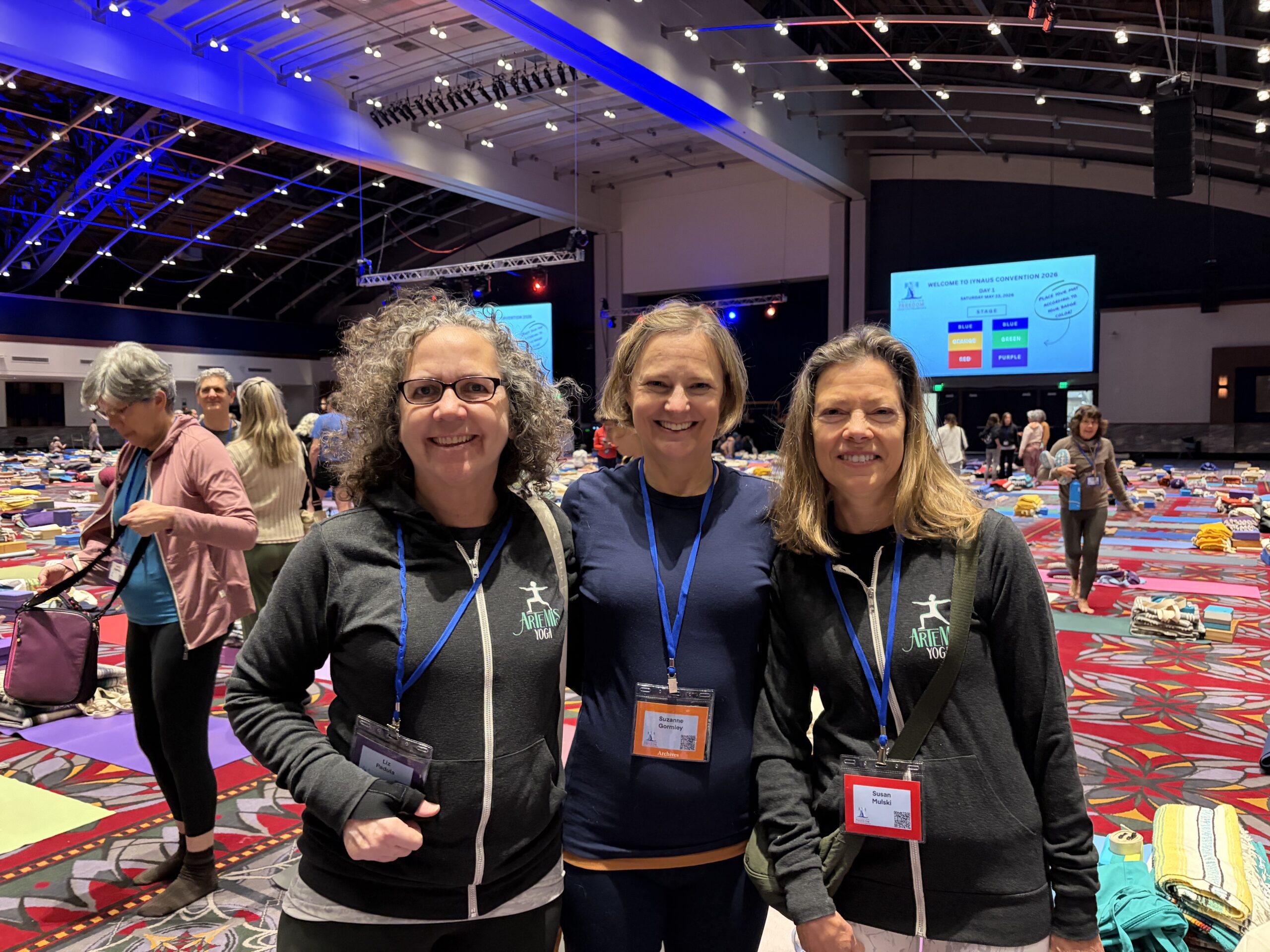
Reflections from Susan Mulski
1. Studentship: At the convention, Abhijata spoke about “studentship,” the practice of being an Iyengar student. She emphasized taking responsibility for yourself, trusting your own experience, and learning the poses through your body rather than depending entirely on a teacher to explain everything. This deeply resonated with me. After 24 years of yoga, I have come to rely more and more on my home practice, and I appreciated her encouragement to find my own way.
2. Personal Growth: This was my fourth Iyengar yoga convention. When I reflect back, each one was a different me practicing yoga. My first (Boca Raton ) I wanted to do as many asanas as physically possible. By the second (Dallas) I was a certified teacher and I eagerly wrote copious notes on Abhijata’s teachings. The third (San Diego) was post Covid and I was just so grateful to be in person, practicing with others. This fourth one (Philadelphia) I was less concerned with doing every asana perfectly, didn’t take notes, and confidently placed my mat in front of the stage. I also mustered the courage to introduce myself to some senior teachers. But the highlight of this convention was having fun socializing with my yoga friends. I appreciate them more every year.
2. Freedom from Fear: Abhijata opened the conference by asking, “What do you want freedom from?” For me, the answer was freedom from fear. Fear can hold us back in many areas of life. How do we stay positive in the face of change? How do we age with grace without fearing illness in ourselves or in those we love? How do we free ourselves from old habits that keep us tied to the past? I do not have clear answers to these questions, but yoga continues to light my way.
Reflections from Shara Lewis
So much of the convention was deeply impactful, but two things stood out most. First, Abhijata spoke about the importance of teachers continuing to be students of their own experience. And for students, she reminded us that what a teacher offers is a guideline, a starting point. We must keep drawing on our own direct experience rather than relying solely on external instruction.
The second thing that stayed with me was Abhijata’s caution against fixating on what she called “the fruit” the end result, or how we want a pose to look.
It is the work, the steps, the incremental progress along the way that matters, not the final pose, not the final outcome. This felt deeply relevant not only on the mat, but in life.
“The only way to overcome fear is to take action.”
Reflections from Maxine Hart
A major takeaway for me was really rooted in the theme of the convention and that is Cultivating Freedom.
I have been thinking about the question: What are we seeking freedom from?
Abhi’s response to how we face fear was really powerful – ‘the only way to overcome fear is to take action’ this really resonated with me. And her using the fast paced asana session to demonstrate was brilliant!
Since returning from Philly, I actually put into life practice the idea of taking action rather than stay stuck in my head with a million of excuses as to why I couldn’t do something – it was so liberating.
Reflections from Tony DaSilva
The convention was an amazing experience—I felt like Harry Potter arriving at Hogwarts! Abhijata was incredibly grounded, conveying her teachings with vivid metaphors and personal stories about Guruji and Geetaji. I happily listened to her for hours. I was also deeply moved by her generosity; she regularly made herself available for one-on-one discussions with attendees before sessions. I’m so grateful for five solid days of yoga, eating, and resting. I can’t wait to do it again!